





On this page12 sections
- Key Takeaways
- Draw the Line One Step at a Time
- Where APIs Still Win
- Where Agents Belong
- When an Agent Is the Wrong Tool
- Trigger on the API, Finish on the API
- Own the Rules, Embed the Connectivity
- Where Agentic AI for Logistics Goes Next
- Build for the Freight, Not the Demo
- Frequently Asked Questions
- About LSP44
- About the Author
Key Takeaways
- Agentic AI for logistics works when each freight step gets the right tool.
- APIs still win tracking, rating, tendering, and booking.
- Agents earn their keep on exceptions, documents, carriers with no feed, and judgment calls.
- Bots that ask carriers what an API already knows add cost and bot fatigue.
- Trigger agents on API exceptions and finish the work through APIs.
My favorite agentic AI demo of 2026 is one I’ve seen about a dozen times. An agent calls a carrier, asks where the truck is, gets an answer, and updates the shipment. Everyone seems impressed. Nobody mentions that the truck reported its location through an API five minutes earlier, without making small talk with a dispatcher.
Apparently, we’ve invented a more expensive way to ask a question we already know the answer to.
I spent years building enterprise software, most recently at Stripe, and watching some of these demos makes me wonder when we decided every problem needed a conversation. Sometimes you need an agent to sort through conflicting information, chase down an exception, or make a judgment call. Sometimes you need an API to move data from one system to another. Knowing the difference is central to how we’re building agents and APIs at LSP44.
Gartner has put agentic AI at the Peak of Inflated Expectations, which feels about right. Everyone wants an agent, preferably everywhere, and preferably yesterday.
I think agentic AI for logistics has enormous potential. I also think freight operators who’ve survived two recessions are right to ask whether we’re solving their problems or giving old problems a very expensive personality.
Draw the Line One Step at a Time
The easiest way to avoid giving every freight problem an expensive personality is to ask two questions: Is there one right answer, and does a system already have it?
If both answers are yes, use an API. Nobody needs an AI agent pondering a truck’s GPS coordinates.
Follow a load from quote to invoice, and you’ll see why. Rate lookups, location updates, and routine status checks already have reliable ways to get done. Agents become useful when the information doesn’t add up, something goes wrong, or the next move isn’t obvious.
Gartner made a similar point in June 2025, warning that plenty of supposedly agentic use cases don’t need agents at all. It also predicted over 40% of agentic AI projects would be canceled by 2027.
I’d rather make that distinction before buying anything. Otherwise, you end up collecting agents from different vendors, each bringing another integration to maintain. We call it the Integration Tax. Funny how nobody puts that on the demo slide.
Where APIs Still Win
Nobody should be paying an AI agent to chase information an API can deliver in seconds. Yet that’s exactly what happens when companies put agents in charge of tracking, rating, tendering, and booking.
APIs do that work faster, more accurately, and at a fraction of the cost.
Take tracking. LSP44’s network pulls carrier updates through APIs roughly every seven minutes. An agent calling dispatch might get through once an hour, assuming someone picks up. And while a dispatcher might optimistically describe a late truck as “making good time,” GPS coordinates have no such diplomatic instincts.
Speed matters, but so does feedback. A bad API request returns an error almost immediately, giving the system something concrete to fix. That feedback loop also helps power our agent factory.
At scale, API-based tracking costs roughly a tenth of call-based coverage. Even smaller carriers can connect through EDI, telematics, or mobile apps.
Of course, getting fresh data and getting a useful answer aren’t always the same thing. That’s where agents get interesting.
Where Agents Belong
The interesting work starts when the API comes back empty, the paperwork makes no sense, or the carrier’s version of events doesn’t match the GPS. Someone has to figure out what’s happening, and I’d rather have an agent chase the answer than another dispatcher lose half an afternoon.
ARC’s Jim Frazer makes a similar case for starting with exception management. We’re already seeing it work at LSP44. Lineage Logistics uses our Dispatch Agent on FTL cold-chain shipments to contact carriers and recover missing shipment identifiers. A small problem, perhaps, until you’re handling thousands of loads.
Paperwork offers another opening. Armstrong & Associates found that only about half of freight forwarders had automated documentation and invoicing by June 2026. That’s a lot of people still babysitting PDFs.
Agents can also help weigh cost against service when choosing a backup carrier. We’ve mapped these opportunities in our guide to agent capabilities and Agent Job Board.
The trick is knowing when the agent should hand control back.
When an Agent Is the Wrong Tool
My patience runs out when an agent starts doing work we’ve already solved with perfectly good software. Calling a dispatcher for GPS coordinates the truck reported five minutes ago is bad enough. Do it across thousands of shipments, and you’ve built an expensive robocall operation that carriers will quickly learn to ignore.
Bot fatigue is very real and a lousy way to thank people for hauling your freight.
I feel even more strongly about rates and transactions. A language model has no business guessing its way through a tariff table when a rate engine can calculate the exact charge. And tenders, bookings, payments, and settlements need exactly once execution. At Stripe, we used idempotency keys to keep retries from charging customers twice. Freight deserves the same discipline.
Reliability also gets ugly when you string agents together. Twenty steps at 95% accuracy each give you roughly a 36% chance of finishing cleanly.
I’d trust an agent to choose a backup carrier. I’d trust an API to tender the load. Getting that handoff right matters far more than another impressive demo.
Trigger on the API, Finish on the API
Getting that handoff right starts with a rule: let the API spot the problem, give the agent room to solve it within agreed limits, and send the result back through an API. Simple enough, although you’d be surprised how many vendors manage to complicate it.
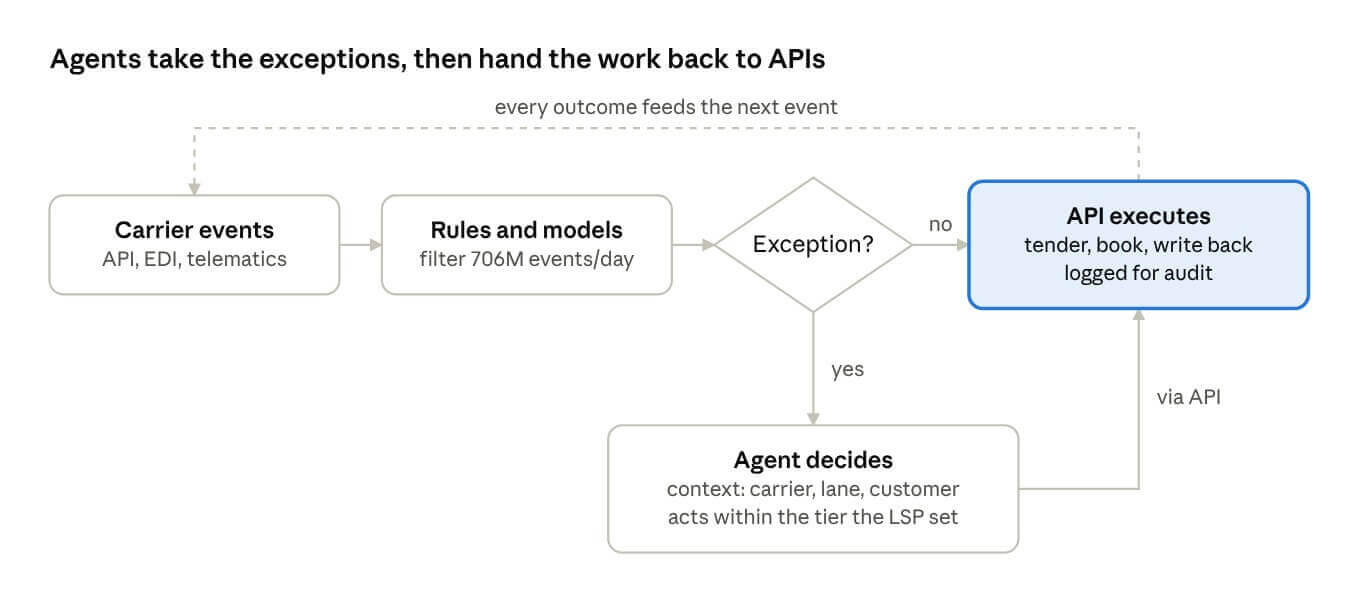
Take proof of delivery. A poorly designed agent calls every carrier four days after pickup asking for a POD, regardless of whether one exists. Congratulations, you’ve automated annoying your carriers.
I’d rather trigger the workflow when the API confirms delivery, then check what’s missing. Some LTL carriers batch paper PODs days later, while drivers with digital handhelds capture signatures immediately. The agent should know the difference, call only when necessary, and return the document through the API.
At LSP44, customers control that authority through four tiers: Observe, Recommend, Act with approval, and Act autonomously. Permissions vary by customer, lane, and dollar threshold, with every action logged and SLAs tracked through our Observability layer.
Every box in that above diagram has an owner, and the ones your customers see should be yours.
Own the Rules, Embed the Connectivity
Ownership matters because an LSP shouldn’t have to surrender its customer relationships or operating playbook to get better technology. That’s the thinking behind Agentic Infrastructure for LSPs. You own the rules, the decisions, and the customer experience. We provide the carrier connectivity and event data through APIs you embed in your own products.
BlueGrace CEO Bobby Harris said it well at our July launch: “Nobody should be rebuilding carrier connectivity from scratch.” I agree. Connect Once lets you start with the connections your first workflow needs and expand from there. Half of carrier connections go live within hours, and the first agent can deploy in a week.
Of course, trusting us with your rates and lanes deserves more than a nice architecture diagram. We commit to never:
- Operate as an NVOCC
- Operate as an indirect air carrier
- Seek freight brokerage or motor carrier authority
- Train models for other LSPs on your data
- Resell your data to shippers or feed it into project44’s shipper products
The principle behind all five is pretty straightforward: we’ll never compete with our customers. You have enough competitors already.
Where Agentic AI for Logistics Goes Next
I hope some of the agents we’re building today are out of a job in two years. Seriously. If an ocean carrier finally offers an API for rates and bookings, why would I keep paying an agent to chase that information? Give the routine work to the API and let the agent handle the next problem nobody anticipated.
That’s where I see agentic AI for logistics heading: fewer agents doing unnecessary work, more intelligence coordinating the parts of freight that refuse to cooperate.
Having said that, the industry has some catching up to do. BCG surveyed 30 major logistics companies in August 2026 and found only 13% seeing measurable financial returns from AI. Even more telling, 80% named a standalone tool as their most impactful AI deployment.
We’ve gotten pretty good at buying clever tools. Connecting them into an operation that actually runs better is another matter.
My bet is that the winners won’t count how many agents they’ve deployed. They’ll know exactly when to retire one.
Build for the Freight, Not the Demo
When I joined LSP44, I said project44 had already done the hardest part of making AI useful: building the data, network, and context to run it in production. I stand by that. We’re talking 280,000+ carriers, 706 million events a day, and infrastructure supporting nine of the world’s 10 largest logistics providers.
Good luck replicating that with a clever prompt.
Everything I’ve argued here comes back to putting that infrastructure to work intelligently. Let APIs handle reliable data and transactions. Give agents the exceptions worth investigating and the judgment calls they’re authorized to make. Keep the rules and customer relationships yours.
The economics deserve attention, too. At a typical 3PL operating margin of 5% to 8%, saving $1 can deliver the same operating profit as roughly $16 in additional revenue. Our Integration Tax Calculator helps put a number on it.
Better yet, bring us one exception your team still handles manually. We’ll show you where an agent earns its place and where an API can do the job without the theatrics.
Frequently Asked Questions
What Is Agentic AI for Logistics?
Agentic AI for logistics means AI agents working toward a freight objective, like recovering a late load or a missing POD, across your systems and within limits you set. The agent is the worker, and it gets things done by calling APIs.
Should Logistics Automation Use AI Agents or APIs?
Both, split by step. Use an API wherever a carrier system can answer exactly: rate lookups, status checks, tenders, bookings. Give agents the steps that need interpretation, and have them execute through the same APIs so every action is logged.
When Do AI Agents Make Sense in Freight Operations, and When Do They Not?
They make sense on exceptions flagged in API data, emails, and PDFs, carriers with no feed, and calls that trade cost against service. They don’t when a feed already knows the answer, the math is fixed, a transaction must run exactly once, or context is missing.
Do AI Agents Replace a TMS or EDI Connections?
No. Your TMS stays the system of record, and EDI and APIs stay the pipes. Agents read events from those systems and write results back through them. Your TMS manages the record. LSP44 executes the work.
How Should an LSP Measure Whether an AI Agent Is Working?
Count finished work, like exceptions resolved and loads recovered, against exceptions flagged. ARC’s Jim Frazer suggests watching that ratio. If alerts climb while resolutions stay flat, you’ve bought visibility without control. Every agent action should also land in an audit log.
About LSP44
LSP44 is the AI-native agent and API infrastructure business for logistics service providers, built on project44’s data graph, profitable, and headquartered in Chicago.
About the Author
Vinay Mathur is Founding CTO of LSP44 and leads engineering, platform infrastructure, and applied AI for LSP44 and project44. He joined from Stripe, where he led product engineering for its revenue suite and its AI data products and pipelines, after engineering leadership roles at SAP Ariba, GEP Worldwide, and Microsoft Dynamics 365.
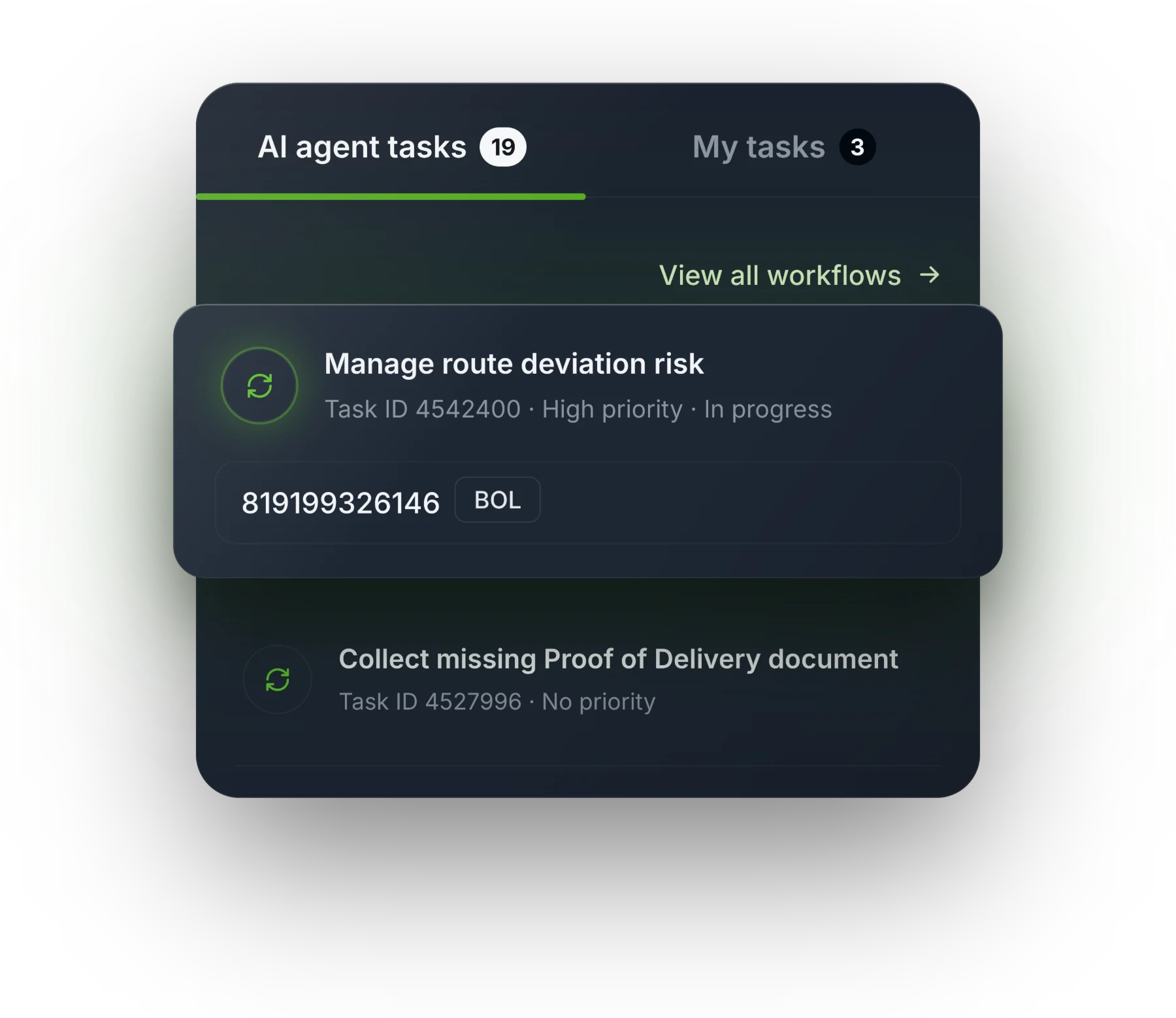
Watch AI agents handle the check calls, PODs and exceptions your team runs by hand today.
Watch a demo